

Events Industry Market to Reach USD 5,136.11 Billion by 2035, Growing at 11.8% CAGR
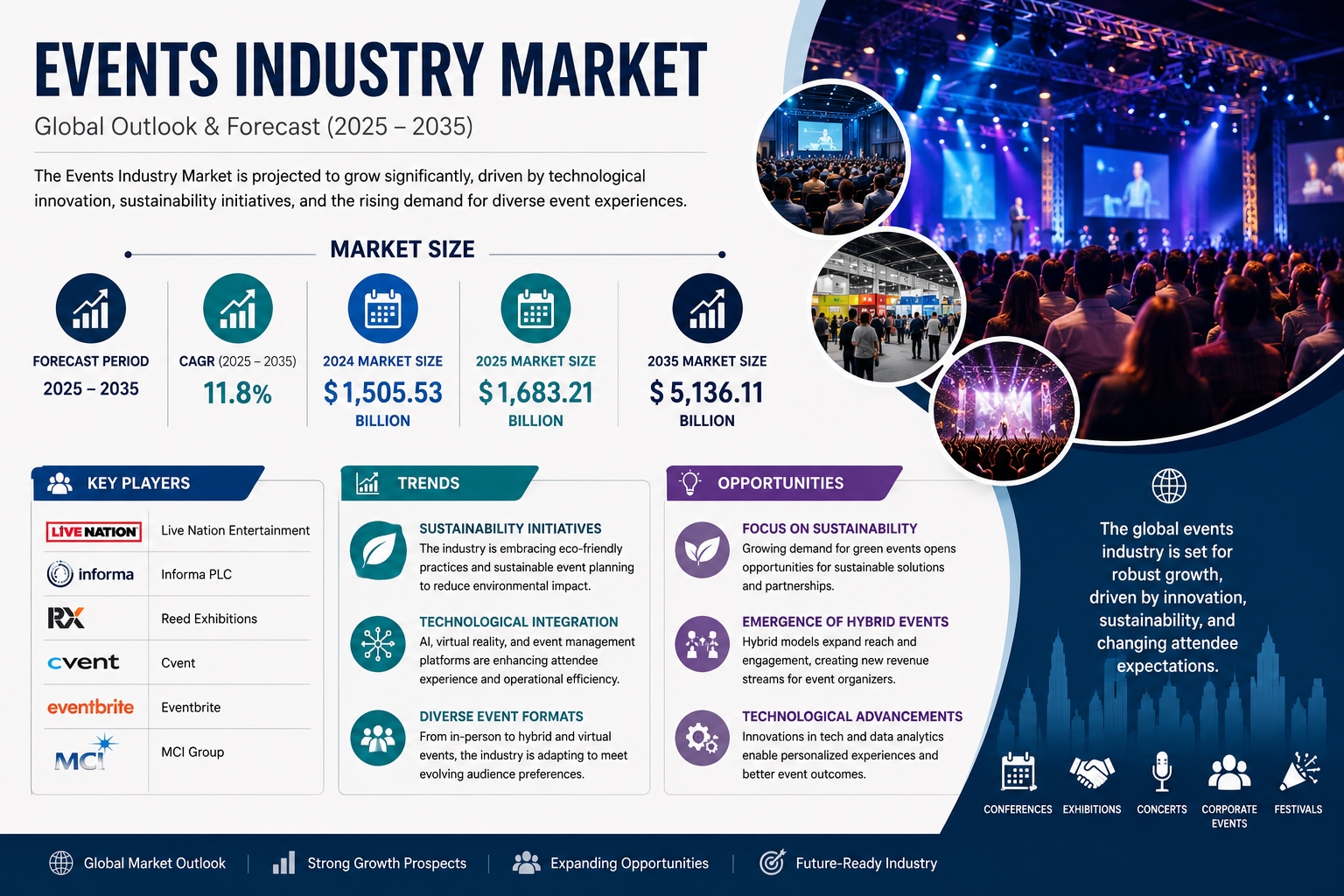
Events industry market
Rising corporate investment, hybrid formats, and technology integration are driving robust expansion across the global events industry landscape.
The events industry is no longer just about filling seats it is becoming a data-driven, technology-enabled ecosystem where sustainability, personalization, & hybrid engagement determine brand loyalty.”
NEW YORK, NY, UNITED STATES, July 22, 2026 /EINPresswire.com/ -- The global Events Industry Market is charting a decade of exceptional expansion, with its valuation projected to climb from USD 1,683.21 billion in 2025 to USD 5,136.11 billion by 2035, registering a compound annual growth rate (CAGR) of 11.8% across the forecast period 2025–2035. The market was valued at USD 1,505.53 billion in 2024, underscoring a rapid acceleration in growth as corporations, brands, and consumers alike lean into live, hybrid, and virtual experiences as central pillars of engagement, marketing, and community building.— Market Research Future (MRFR)
The events industry — spanning music concerts, festivals, sports competitions, exhibitions and conferences, corporate events and seminars, and a broad range of other gatherings — has evolved from a largely logistics-driven service sector into a technology-infused, experience-centered economy. What was once measured primarily in ticket counts and venue capacity is now assessed through sponsorship value, digital engagement metrics, sustainability credentials, and cross-format audience reach. This transformation is positioning the events industry as one of the more dynamic growth engines within the broader consumer and retail landscape.
Market Overview: A Decade of Accelerated Growth
The events industry sits at the intersection of entertainment, corporate strategy, tourism, and technology. As businesses increasingly recognize the value of face-to-face interaction for brand building, and as consumers continue to prioritize experiences over material purchases, demand for professionally organized, well-produced events has surged across nearly every category — from stadium concerts and cultural festivals to trade exhibitions and corporate seminars. An 11.8% CAGR through 2035 signals structural, long-term demand growth rather than a short-lived post-pandemic rebound, suggesting that live and hybrid events have become deeply embedded in how organizations market themselves and how consumers choose to spend their leisure time and disposable income.
This growth trajectory is further reinforced by continuous innovation in event technology — including AI-powered planning platforms, immersive augmented and virtual reality experiences, and increasingly sophisticated hybrid broadcast infrastructure — that allow organizers to reach larger, more geographically dispersed audiences without sacrificing the intimacy and impact of in-person engagement. As a result, formats once limited by venue capacity or geography are now scaling globally, expanding the addressable market well beyond traditional physical attendance.
Get Full PDF Sample Copy of Report: (Including Full TOC, List of Tables & Figures, Chart) @ https://www.marketresearchfuture.com/sample_request/12035
Market Segmentation: Diverse Formats Across Type, Revenue, Organizer, and Audience
The Events Industry Market report from Market Research Future segments the industry across four principal dimensions, each offering a distinct lens into where growth is concentrated.
By Type, the market spans Music Concerts, Festivals, Sports, Exhibitions and Conferences, Corporate Events and Seminars, and Others. Music Concerts currently represent the dominant category, anchored by high-profile artists, substantial production investment, and strong sponsorship and media attention. Festivals, meanwhile, have emerged as the fastest-growing format, propelled by their appeal to younger, experience-driven audiences and their ability to blend diverse genres, cultural elements, and community-oriented programming. As festivals increasingly weave in technology and sustainability practices, they are becoming an especially attractive proposition for both attendees and sponsors seeking authentic engagement.
By Revenue Source, the market is categorized into Ticket Sale, Sponsorship, and Others. Ticket sales remain the largest revenue contributor, reflecting the continued centrality of attendee participation to event economics, while sponsorship is the fastest-growing revenue stream as brands increasingly view association with high-profile events as a strategic vehicle for targeted exposure and measurable return on investment. Industry estimates indicate ticket sale revenue is projected to reach USD 2,100.0 billion by 2035, reinforcing the enduring importance of direct attendee monetization even as sponsorship models mature.
By Organizer, the market serves Corporate, Sports, Education, Entertainment, and Other organizers. Corporate events — including business conferences and seminars — represent the largest organizer segment, driven by sustained demand for networking, professional development, and brand promotion in professional settings. The sports segment, while comparatively smaller today, is the fastest-growing organizer category, fueled by rising participation in recreational and professional sports, the growing popularity of e-sports, and expanding sponsorship interest; the segment is projected to generate USD 1,025.83 billion in revenue by 2035.
By Age Group, the market is divided into audiences Below 20 Years, 21–40 Years, and Above 40 Years. The 21–40 age cohort currently commands the largest share of event attendance and spending, reflecting a demographic that actively prioritizes experiences, social interaction, and networking over material goods. The Below 20 Years segment is the fastest-growing audience group, driven by expanding youth-focused programming such as e-sports tournaments, interactive workshops, and youth-oriented festivals. Notably, as disposable income and event participation patterns shift over the coming decade, the Above 40 Years cohort is projected to become the leading revenue contributor by 2035, with an estimated USD 2,581.67 billion in spending, highlighting the growing importance of premium, experience-rich programming tailored to older, higher-spending audiences.
By Geography, the market spans North America, Europe, Asia-Pacific, and the Rest of the World. North America remains the largest regional market, while Asia-Pacific is emerging as the fastest-growing region, driven by rising urbanization, expanding middle-class populations, and increasing corporate investment in exhibitions and conferences.
Key Trends Shaping the Market Through 2035
The Market Research Future report identifies several defining trends shaping the trajectory of the global events industry over the next decade.
Sustainability Initiatives. Environmental responsibility has moved from a peripheral consideration to a central pillar of event planning. Organizers are increasingly adopting sustainable materials, waste-reduction strategies, and energy-efficient logistics, with more than 60% of events expected to incorporate formal sustainability measures in 2025 alone. This shift reflects both regulatory pressure and growing attendee and sponsor expectations around environmental accountability, and is increasingly viewed as a differentiator that enhances brand reputation while, in many cases, reducing operational costs.
Technological Integration. Advanced technologies — including artificial intelligence, augmented reality, and virtual reality — are fundamentally reshaping how events are conceived, marketed, and delivered. AI-driven platforms are streamlining event logistics, personalizing attendee experiences, and enabling more precise, data-driven decision-making, while AR and VR tools are creating immersive engagement opportunities that extend well beyond the physical venue. Technology-related expenditure within the events industry is projected to exceed USD 15 billion in 2025, underscoring how central digital infrastructure has become to modern event execution.
Diverse Event Formats. Consumer and corporate expectations are driving a proliferation of new event formats, most notably hybrid events that combine in-person and virtual participation. Hybrid formats are projected to account for more than 40% of all events in 2025, reflecting organizers' efforts to maximize reach, flexibility, and inclusivity. Alongside hybrid formats, niche and community-focused gatherings tailored to specific interests, cultures, or demographics are gaining traction, with events targeting specific cultural groups projected to rise by 25% in 2025 — a trend that is reshaping how organizers approach audience segmentation and programming.
Market Drivers and Opportunities
Several structural factors underpin the sustained growth outlook for the global events industry.
Focus on Sustainability. As environmental awareness continues to influence consumer and corporate decision-making, sustainability has become a meaningful growth lever rather than a compliance burden. Organizers who embed eco-friendly practices into venue selection, materials sourcing, and logistics are increasingly able to appeal to environmentally conscious attendees and sponsors while simultaneously improving operational efficiency.
Emergence of Hybrid Events. The blending of in-person and virtual experiences continues to transform how events are designed and monetized. By enabling organizers to reach audiences well beyond the physical constraints of a venue, hybrid formats are expanding both attendance and revenue potential, while also creating new data streams that allow for more sophisticated audience insight and targeted sponsorship packages.
Technological Advancements. The accelerating adoption of AI, AR, and data analytics across event planning, marketing, and execution is enabling more personalized, efficient, and measurable events. As these technologies mature and become more cost-accessible, they are expected to unlock further innovation in attendee engagement and operational management across all event categories.
Increased Corporate Investment. Businesses are allocating growing budgets toward experiential marketing, recognizing live events as a high-impact channel for brand engagement and customer relationship building. Corporate spending on events is estimated to reach approximately USD 30 billion in 2025, reflecting a broader strategic shift toward face-to-face interaction as a driver of customer loyalty and brand differentiation.
Diverse Audience Engagement. As demographic and cultural diversity continues to shape consumer expectations, organizers are increasingly tailoring programming to specific audience segments. This trend is fostering more inclusive, community-oriented event experiences that strengthen attendee loyalty and open new avenues for growth across previously underserved audience groups.
Emerging opportunities are particularly notable in the integration of augmented and virtual reality experiences for attendees, the development of sustainable event solutions and practices, and the continued expansion of virtual and hybrid event platforms that extend global reach beyond traditional venue-based limitations.
Competitive Landscape: Global Leaders Driving Innovation
The Events Industry Market remains characterized by a mix of large, established multinational players and a long tail of specialized regional operators. Key companies profiled in the report include Live Nation Entertainment (US), Informa PLC (GB), Reed Exhibitions (GB), Cvent (US), Eventbrite (US), MCI Group (CH), Clarion Events (GB), Emerald Expositions (US), and UBM (GB), alongside other notable participants such as Access Destination Services, BCD Group (BCD Meetings & Events), ATPI Ltd., Anschutz Entertainment Group, StubHub, Capita Plc, Questex LLC, The Freeman Company, and Seven Events Ltd.
These industry leaders are pursuing a range of strategic initiatives to strengthen their market positions, including sustained investment in event technology platforms, expansion of venue portfolios and production capabilities, strategic partnerships with sponsors and media organizations, and continued geographic expansion into high-growth regions. Live Nation Entertainment, for example, maintains a global footprint spanning concert promotion, venue ownership and operation, and ticketing services across the Americas, Europe, and Asia, while diversified players such as Capita Plc extend event-adjacent capabilities across technology, consulting, and business process management. Many companies across the competitive landscape are also investing in sustainability programs and digital infrastructure as environmental, social, and governance (ESG) considerations become increasingly influential in both sponsorship decisions and consumer preferences.
Beyond these established players, the market continues to see growing activity from specialized regional organizers and technology-driven entrants focused on niche formats, hybrid production, and data-driven attendee engagement — dynamics that are expected to intensify competition and accelerate innovation across the industry through 2035.
Regional Dynamics
North America remains the clear market leader, accounting for approximately 40% of the global events industry, supported by a robust economy, rising disposable income, and strong corporate demand for live engagement and entertainment. The United States alone contributes around 35% of the total global market share, with the competitive landscape shaped by major players such as Live Nation Entertainment, Cvent, and Eventbrite, alongside a dense calendar of trade shows, conventions, and festivals that reinforce the region's leadership position.
Europe holds an estimated 30% share of the global market, underpinned by strong business tourism, a rich cultural heritage, and regulatory frameworks that support large-scale international events and trade shows. Germany represents the region's largest single market at approximately 15% of the total, followed closely by the UK and France, with key players including Informa PLC and Reed Exhibitions anchoring the competitive landscape through high-profile trade fairs and cultural festivals.
Asia-Pacific, holding approximately 25% of the global market, stands out as the fastest-growing region, propelled by rapid urbanization, an expanding middle class, and rising corporate investment in exhibitions and conferences. China alone contributes an estimated 12% of the global market, with additional growth momentum from India, Japan, and South Korea. Government-backed tourism and business-event initiatives, combined with the rise of major event hubs such as Shanghai, Tokyo, and Sydney, are reinforcing the region's long-term growth trajectory.
The Middle East and Africa, while currently representing a smaller share at around 5% of the global market, are demonstrating meaningful growth momentum. The UAE — particularly Dubai — leads the region at approximately 3% of the global total, supported by significant infrastructure investment, rising tourism, and strong government backing for hosting international conferences and exhibitions. South Africa and Saudi Arabia round out the region's leading markets, with players such as Emerald Expositions and UBM active in the competitive landscape.
Market Restraints and Challenges
Despite the strongly positive growth outlook, the events industry faces several notable challenges. Rising production, venue, and logistics costs continue to pressure organizer margins, particularly for large-scale exhibitions and conferences that require significant upfront investment. Regulatory variation across regions — spanning permitting, safety requirements, and large-gathering restrictions — can complicate cross-border event planning and execution, while ongoing supply chain and logistics volatility poses risk to production consistency, particularly for touring concerts and major festivals.
Additionally, as hybrid and virtual formats proliferate, organizers face growing pressure to justify return on investment across increasingly fragmented distribution channels, requiring more sophisticated measurement tools to demonstrate value to sponsors and corporate stakeholders. Competition for consumer discretionary spending — from other leisure and entertainment categories — also remains an ongoing consideration for organizers seeking to sustain attendance growth across ticketed formats.
Outlook
With the market projected to expand from USD 1,683.21 billion in 2025 to USD 5,136.11 billion by 2035, the global events industry is positioned for more than a decade of sustained, technology-enabled growth. Organizers and technology providers that successfully combine immersive, sustainable event design with data-driven personalization and flexible hybrid delivery are likely to capture disproportionate share of this expanding market. As corporate marketing budgets continue to shift toward experiential engagement and as consumers worldwide continue to prioritize live, shared experiences, the events industry is set to play an increasingly central role in the future of entertainment, commerce, and community connection.
Discover Related Research Reports By Market Research Future:
Corporate Luxury Event Market
https://www.marketresearchfuture.com/reports/corporate-luxury-event-market-28540
K-Pop Event Market
https://www.marketresearchfuture.com/reports/k-pop-event-market-33681
Event Exhibition Market
https://www.marketresearchfuture.com/reports/event-exhibition-market-42352
Sagar Kadam
Market Research Future
+ +1 628-258-0071
email us here
Legal Disclaimer:
EIN Presswire provides this news content "as is" without warranty of any kind. We do not accept any responsibility or liability for the accuracy, content, images, videos, licenses, completeness, legality, or reliability of the information contained in this article. If you have any complaints or copyright issues related to this article, kindly contact the author above.
